
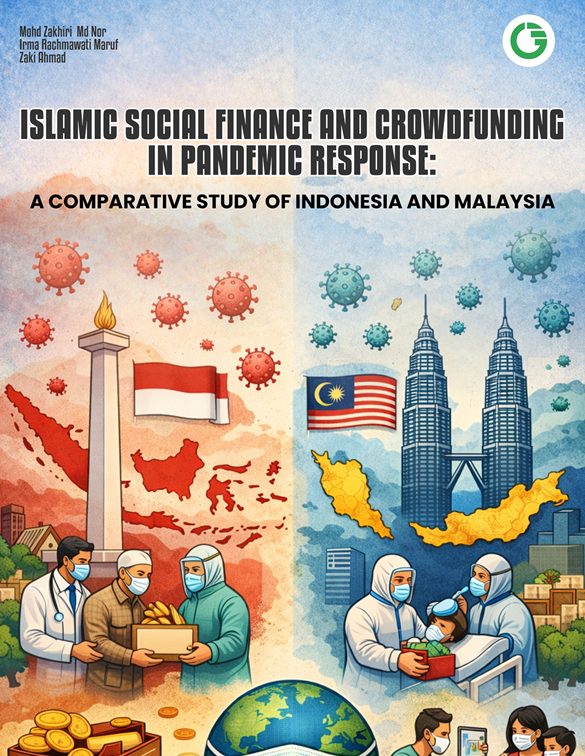
Islamic Social Finance and Crowdfunding in Pandemic Response: A Comparative Study of Indonesia and Malaysia
Rp150.000
Deskripsi
Islamic Social Finance and Crowdfunding in Pandemic Response:
A Comparative Study of Indonesia and Malaysia
Authors:
Mohd Zakhiri Md Nor
Irma Rachmawati
Maruf Zaki Ahmad
Cover Design:
Nur Muhamad Safi’i
Layout:
Komarudin
Editor:
Komarudin
Editor:
Komarudin
Jumlah Halaman:
113 Halaman
ISBN : 9786347194817
Penerbit:
Green Publisher Indonesia
*Sinopsis*
The COVID-19 pandemic opened the world’s eyes to the fact that a crisis does not only attack health, but also shakes social, economic, and humanitarian resilience. When many families lost their income, healthcare workers needed protection, and vulnerable groups struggled to access assistance, a new movement of solidarity emerged through digital spaces: social crowdfunding. In Indonesia and Malaysia, this movement grew as a bridge of kindness, connecting public concern with real needs on the ground. Through small donations from many people, assistance could move faster, reach wider, and arrive at moments when formal relief systems were not always able to respond immediately.
This book invites readers to understand how social crowdfunding can become an important part of Islamic social finance. Values such as zakat, waqf, infaq, and sadaqah are no longer understood only in their traditional forms, but can also live within a more open, participatory, and adaptive digital ecosystem. Within the framework of Maqasid Shariah, particularly the preservation of life (hifz al-nafs) and the protection of wealth (hifz al-mal), social crowdfunding shows that technology can become a pathway to protect lives, ease burdens, and strengthen community welfare. Assistance for personal protective equipment, oxygen, food, healthcare costs, and small business support provides concrete examples of how humanitarian values and Islamic values can work together in facing a crisis.
However, great acts of kindness still require strong governance. Public trust is not born only from good intentions, but also from transparency, accountability, legal protection, and trustworthy fund management. For this reason, this book highlights the important role of regulation in Malaysia and Indonesia in building a more credible crowdfunding ecosystem. Rules concerning digital platforms, fund reporting, donor protection, and Shariah compliance serve as a foundation so that crowdfunding does not remain merely a spontaneous movement during a crisis, but can also develop into a sustainable Islamic social finance instrument.
Through its discussion of the experiences of Indonesia and Malaysia, this book shows that social crowdfunding is not merely a way to collect funds, but also a reflection of the power of mutual cooperation, trust, and community solidarity. Amid increasingly rapid technological change, new opportunities such as blockchain and artificial intelligence can strengthen transparency, prevent misuse, and expand social impact. Ultimately, this book affirms that the future of Islamic social finance lies in the ability to combine spiritual values, social concern, technological innovation, and responsible governance—so that kindness does not stop as a temporary response, but grows into a force that builds long-term welfare.



Ulasan
Belum ada ulasan.